Yono Rummy Terms Every Beginner Should Know
Learning a new card game can feel confusing when you come across unfamiliar words such as pure sequence, wild joker, discard pile and valid declaration. Understanding these terms makes it easier to follow the rules, organise your cards and understand how a round is scored.
If you are exploring Yono Rummy, getting familiar with common rummy terminology is a useful first step before playing. Many versions of rummy share similar concepts, although their hand sizes, scoring methods and declaration rules can differ.
This beginner-friendly guide explains the most important rummy terms with simple examples. It covers card combinations, gameplay actions, scoring expressions and common game formats so you can understand the language used in rummy rules.
1. Basic Rummy Terms
Start with these everyday terms to understand how a typical rummy round works.
1. Hand
A hand is the collection of cards dealt to a player at the beginning of a round.
In Indian 13-card Rummy, each player generally receives 13 cards. Other variations, such as Gin Rummy, use a different number of cards.
Example: If you receive 13 cards at the start of an Indian Rummy round, those cards make up your hand.
2. Deck
A deck is the set of playing cards used in a game. Depending on the format, a rummy game may use one or more standard decks, sometimes with printed jokers.
The number of decks and jokers can vary, so check the rules for the particular version you are learning.
3. Deal
A deal is a round or hand of play in which cards are distributed and players attempt to meet the game’s objective.
In some formats, several deals make up a larger match. Deals Rummy, for example, uses a fixed number of deals under its rules.
4. Draw Pile
The draw pile, also called the stock pile in many card games, contains cards available for players to draw during their turns.
A player generally draws a card from the available pile or takes a permitted card from the discard pile, depending on the rules.
5. Discard Pile
The discard pile contains cards that players have thrown away during their turns.
In many rummy games, players draw a card and discard one as part of their turn. The rules determine whether and how the top discarded card can be picked up.
6. Turn
A turn is the period when a player performs the actions allowed by the game rules.
In a typical rummy turn, a player draws a card, arranges their hand and discards a card. The precise order and permitted actions depend on the format.
2. Card Combination Terms
Card combinations are central to many rummy variations. In Indian Rummy, understanding sequences and sets is particularly important.
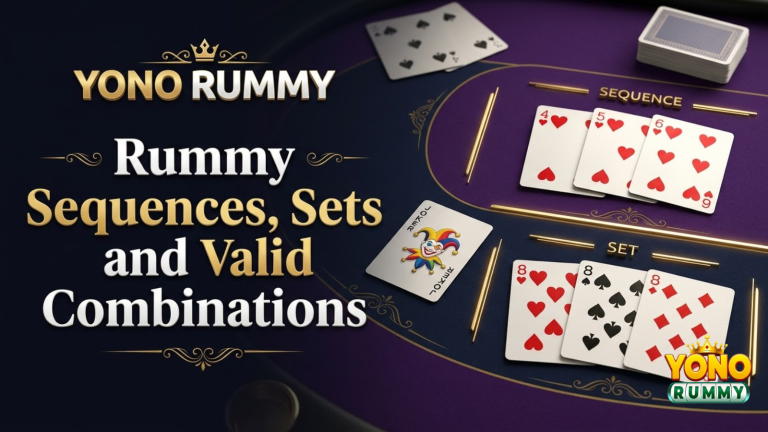
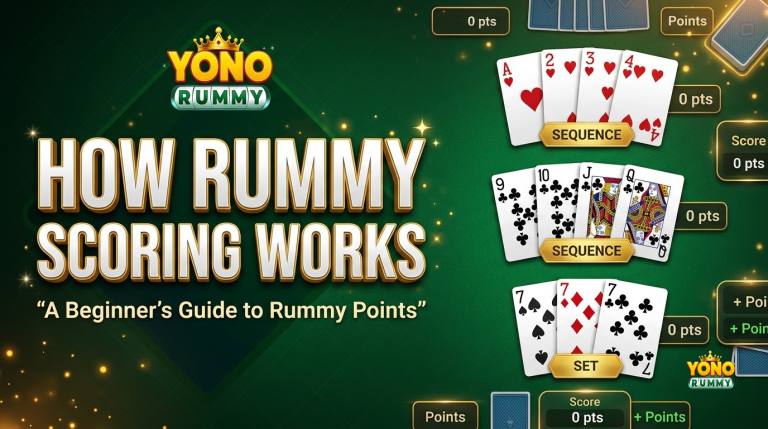
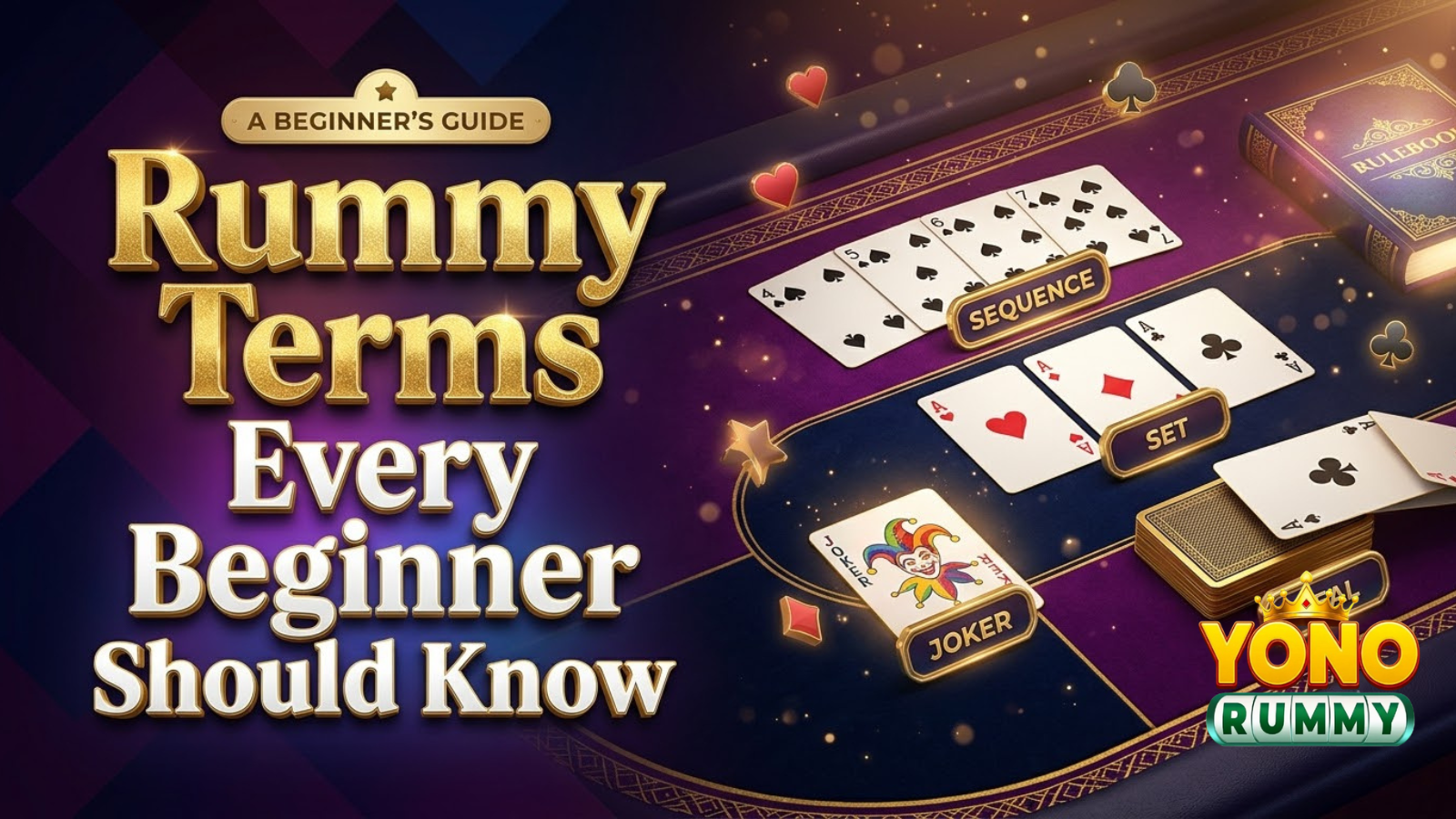
7. Sequence
A sequence is a group of consecutive cards of the same suit.
For example:
- 4♥, 5♥, 6♥
- 8♠, 9♠, 10♠
Each example contains consecutive ranks in the same suit.
Sequences help players organise their hands into valid combinations.
8. Pure Sequence
A pure sequence is a sequence formed without using a joker as a substitute for a missing card.
For example, 5♦, 6♦ and 7♦ form a pure sequence.
In standard Indian Rummy, a valid declaration generally requires at least one pure sequence. Always check the rules of the particular game before making a declaration.
9. Impure Sequence
An impure sequence is a sequence that uses a permitted joker to replace a missing card.
For example, 5♣, a joker representing 6♣, and 7♣ may form an impure sequence where the rules allow that use of the joker.
The joker must satisfy the game’s combination rules. It cannot automatically be used in every situation.
10. Set
A set is a group of cards of the same rank in different suits.
For example:
- 9♥, 9♠, 9♦
- K♣, K♦, K♥
These combinations contain cards of the same rank.
The rules may restrict how suits and jokers can be used in a set, so the examples should be treated as illustrations of the basic concept.
11. Meld
A meld is a valid group of cards formed according to the rules of a particular rummy variation.
The word is often used in games such as Gin Rummy. A meld may be a set or a run, depending on the game’s terminology.
In Indian Rummy discussions, players more commonly talk about sequences and sets.
12. Joker
A joker is a card that can substitute for another card in eligible combinations, according to the game’s rules.
There are different joker types, and their functions depend on the format being played.
13. Printed Joker
A printed joker is a joker card included in the deck, usually marked with a distinctive illustration or label.
In many Indian Rummy formats, it can substitute for a card in an eligible combination. The exact rules should be checked before use.
14. Wild Joker
A wild joker is a card designated as a joker for a particular game. In some Indian Rummy formats, a randomly selected card rank becomes the wild-card rank for that round.
For example, if 8 is selected as the wild rank, cards of that rank may act as jokers under the game’s rules.
Not every variation selects wild jokers in the same way.
3. Gameplay and Declaration Terms
These terms describe the actions and conditions that can determine how a rummy round ends.
15. Declare or Declaration
A declaration is the action of announcing that your hand meets the game’s requirements for ending the round.
In Indian Rummy, a player generally needs to arrange the required valid combinations before declaring. A declaration that does not meet the rules may be treated as invalid and could attract a penalty.
Do not assume that having several sequences is enough; the complete hand must satisfy the format’s requirements.
16. Valid Declaration
A valid declaration means that the player’s hand meets the specific rules for winning or ending the round.
In standard Indian Rummy, this generally includes the required pure sequence and valid grouping of the remaining cards.
The precise requirements can vary by game, so read the rules before relying on a particular arrangement.
17. Invalid Declaration
An invalid declaration occurs when a player declares but their hand does not meet the game’s requirements.
For example, a hand may be missing a required pure sequence or contain combinations that are not valid under the rules.
The resulting penalty depends on the particular format and platform. Do not assume every game uses the same penalty score.
18. Drop
A drop means leaving a round rather than continuing to play it. In some rummy formats, dropping results in a penalty.
The penalty and the conditions for dropping depend on the game’s rules.
19. First Drop
A first drop generally refers to leaving a round at the earliest permitted opportunity, before continuing further in that round.
Some formats distinguish a first drop from a later drop and assign different penalties. Check the rules to understand when this option is available.
20. Middle Drop
A middle drop generally means leaving after the round has progressed beyond the initial stage.
Its availability and penalty depend on the particular game. The term is especially relevant in formats that distinguish between early and later exits.
21. Show
A show is a term used in some rummy formats for revealing or submitting a hand for evaluation.
Its exact meaning may differ across games. In one format, it may refer to declaring a completed hand; in another, the rules may use it for a different action.
Read the in-game explanation rather than assuming show and declare always mean exactly the same thing.
4. Rummy Scoring Terms
Understanding scoring terminology helps you interpret the result of a round.
22. Points
Points are numerical values assigned to cards or used to calculate a player’s score, depending on the format.
In common Indian Rummy scoring systems, unmatched cards may contribute to a player’s penalty score after another player makes a valid declaration.
Card values and scoring limits should be checked against the rules of the specific game.
23. Unmatched Cards
Unmatched cards are cards that have not been arranged into valid combinations by the end of the round.
For example, if a player’s hand contains a valid sequence but a remaining Queen is not part of any valid set or sequence, that Queen may count towards the player’s unmatched-card score.
The actual calculation depends on the format’s rules.
24. Penalty Points
Penalty points are points assigned when a player does not meet a particular objective or leaves a round under conditions that carry a penalty.
Possible reasons include having unmatched cards when an opponent declares, making an invalid declaration or dropping out of a round.
The penalty is not necessarily the same across all rummy games.
25. Score Limit
A score limit is a points threshold used in certain formats to determine when a player is eliminated or when a match condition is reached.
Pool Rummy commonly uses a target such as 101 or 201 points, depending on the version. The actual elimination and scoring rules should be confirmed for the game being played.
26. Winner
The winner is the player determined to have won the round or match under the game’s rules.
In a typical Indian Rummy round, a player wins by making a valid declaration. In other formats, the winner may be determined after multiple rounds or by a different scoring condition.
5. Common Rummy Game Format Terms
When researching Yono Rummy or other rummy platforms, you may come across the names of different formats. These labels describe how a game is structured, rather than individual card combinations.
27. Points Rummy
Points Rummy is generally organised around individual rounds, with scores calculated under a points-based system.
Where money is involved, the value assigned to each point and the applicable fees or conditions can affect the financial result. Check the terms before participating.
28. Pool Rummy
Pool Rummy is generally played over multiple rounds. Players accumulate scores, and those who reach the specified points threshold may be eliminated.
Common versions include 101 Pool and 201 Pool, although the precise rules may differ.
29. Deals Rummy
Deals Rummy is generally played over a fixed number of deals. Players’ results are tracked across those deals, and the match outcome is determined under the format’s scoring rules.
It differs from Pool Rummy because the match is structured around a predetermined number of deals rather than primarily around a points-based elimination threshold.
These format names are common rummy terminology. Their inclusion here does not confirm that every format is available on Yono Rummy.
6. How These Rummy Terms Work Together
Consider a simplified example from a 13-card Indian Rummy game.
A player has these cards:
- 4♥, 5♥, 6♥
- 8♠, 9♠, 10♠
- K♣, K♦, K♥
- 3♦, 7♣, Q♠, 2♥
The first group is a pure sequence. The second group is another sequence, and the three Kings form a set.
The remaining cards still need to be organised according to the game’s rules. The player cannot assume the hand is ready to declare simply because several valid combinations have been formed.
This example illustrates why terms such as pure sequence, set, unmatched cards and valid declaration matter. Understanding the terminology helps you assess a hand, but the final declaration must still follow the complete rules of the game.
7. Understanding Yono Rummy Terms Before Playing
If you are learning about Yono Rummy, start with the game’s own instructions and use this glossary as a reference for general card-game terminology.
Before participating in a game:
- Confirm which rummy format is available.
- Check the hand size and how cards are drawn and discarded.
- Learn the rules for sequences, sets and jokers.
- Understand the declaration requirements and penalties.
- Review the scoring method and any entry conditions.
The available project information describes Yono Rummy as a multi-game platform with rummy as its primary focus. However, it does not independently confirm every rummy format or every platform-specific rule. Therefore, the general definitions in this article should not be treated as a definitive statement of the platform’s current rules.
If real-money play is involved, check the applicable laws, your eligibility and the potential for losses. Do not treat rummy as a reliable source of income.
Frequently Asked Questions
What are the most important rummy terms for beginners?
Start with hand, deck, draw pile, discard pile, sequence, pure sequence, impure sequence, set, joker, declaration and unmatched cards. These terms help explain the basic gameplay and scoring concepts in many rummy formats.
What does a pure sequence mean in rummy?
A pure sequence is a group of consecutive cards of the same suit formed without using a joker as a substitute for a missing card. Standard Indian Rummy generally requires at least one pure sequence for a valid declaration.
What is the difference between a sequence and a set?
A sequence contains consecutive cards of the same suit, such as 4♥, 5♥ and 6♥. A set contains cards of the same rank in different suits, such as 9♥, 9♠ and 9♦.
What does a joker do in rummy?
A joker can substitute for another card in eligible combinations, subject to the rules. Some games use printed jokers, while others designate a wild joker for the round.
What is a drop in rummy?
A drop means leaving a round rather than continuing to play. Some formats apply a penalty, and the amount can depend on when the player drops and which rules apply.
Are Yono Rummy terms different from standard rummy terminology?
Many basic terms, such as sequence, set and joker, are used broadly across rummy games. However, the meaning of certain actions, scoring terms and penalties may vary by format. Check the current Yono Rummy game rules for platform-specific definitions.
Do all rummy games use the same scoring system?
No. Points Rummy, Pool Rummy, Deals Rummy and other variations can use different scoring and match structures. Always read the rules for the specific format.
Conclusion
Learning rummy terminology makes it easier to understand card combinations, follow turns and interpret scoring rules. Terms such as pure sequence, set, wild joker, valid declaration and penalty points are particularly useful for beginners.
If you are exploring Yono Rummy, use these definitions as a starting point, then confirm the current rules of the format you intend to learn. Knowing the terminology can reduce confusion, but it does not guarantee a winning result. Play responsibly and never risk money you cannot afford to lose.