Different Types of Yono Rummy Games Explained
Yono Rummy is a popular card game with several variations, each offering a different way to form card combinations, complete a hand and calculate points. Some versions focus on quick rounds, while others involve reaching a target score or competing across several deals.
If you are exploring Yono Rummy or learning the basics of card games, understanding the different types of rummy can help you recognise how each format works. Although many variants share the same basic objective, their rules, scoring systems and round structures may differ.
This guide explains the main types of rummy, including Indian Rummy, Points Rummy, Pool Rummy, Deals Rummy and Gin Rummy. It also covers the key differences between them so beginners can understand the terminology before choosing a format to learn.
What Is Rummy?
Rummy is a card game in which players organise cards into valid combinations, generally called sequences and sets. The precise rules depend on the version being played.
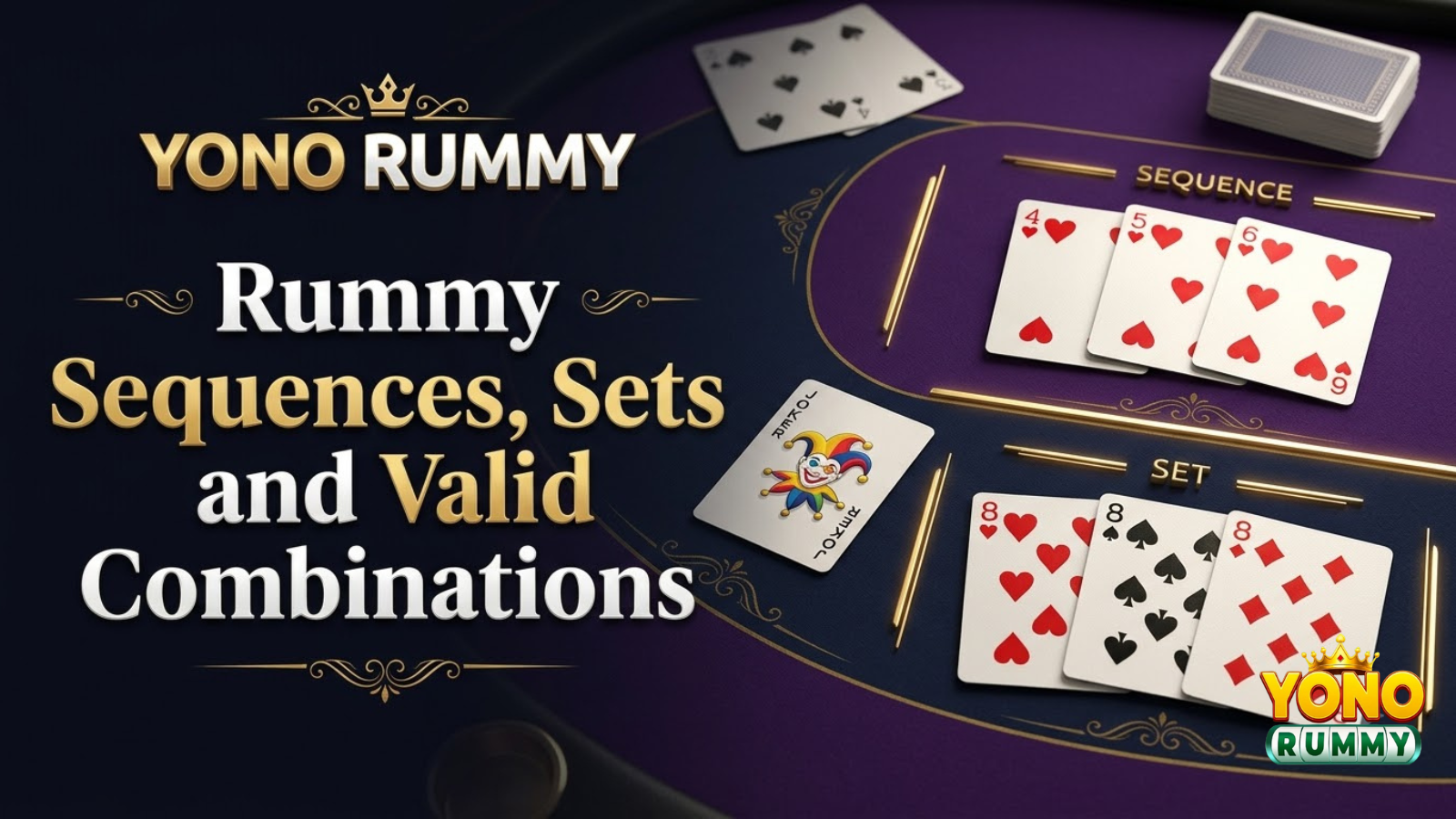
A sequence consists of consecutive cards of the same suit. For example, 4♥, 5♥ and 6♥ form a sequence.
A set consists of cards of the same rank but different suits. For example, 7♥, 7♠ and 7♦ form a set.
In many Indian Rummy formats, players use a 13-card hand and aim to make a valid declaration. A pure sequence is usually essential, and the remaining cards must follow the format’s rules for valid combinations.
Other versions, such as Gin Rummy, use different hand sizes and different rules for ending a round.
7 Different Types of Rummy Games
The term types of rummy can refer to variations of the traditional card game as well as different formats within a particular variation. The following are some of the best-known versions.
1. Indian Rummy
Indian Rummy, often called 13-card Rummy, is a widely recognised version of the game.
Players typically receive 13 cards and draw and discard cards in turn. The aim is to organise the hand into valid sequences and sets according to the rules of the game.
Important features include:
- 13-card hand: Each player generally starts with 13 cards.
- Sequences and sets: Cards are arranged into valid combinations.
- Pure sequence: A sequence without a joker is generally required for a valid declaration.
- Jokers: Printed or wild jokers can help complete eligible combinations.
- Declaration: A player declares when the hand meets the required rules.
For beginners, Indian Rummy is a useful starting point because it introduces the core ideas of drawing, discarding and arranging cards into combinations.
The exact declaration rules and penalties should always be checked for the particular game being played.
2. Points Rummy
Points Rummy is a format in which each round is scored using points, with the value of each point determined by the game’s terms.
In a typical version, players aim to complete a valid hand and declare before their opponents. The other players’ remaining ungrouped cards may contribute to their scores.
Common characteristics include:
- Individual rounds rather than a long match based solely on a cumulative target.
- A scoring system based on unmatched cards and the applicable rules.
- A point value that may determine the monetary value of a round when played for money.
- A focus on completing a valid hand efficiently.
Example: If a player has several unmatched cards when another player makes a valid declaration, the unmatched cards may count towards the player’s penalty score. The precise calculation depends on the game’s rules.
Points Rummy can be easier to understand once you know how sequences, sets and card values work. However, if it is played for money, the financial outcome is not predictable, and losses are possible.
3. Pool Rummy
Pool Rummy is a format in which players compete across multiple rounds while their scores accumulate. The objective is generally to avoid reaching a specified points limit.
Two common formats are:
- 101 Pool Rummy: Players are generally eliminated after reaching the 101-point limit, subject to the game’s rules.
- 201 Pool Rummy: Players are generally eliminated after reaching the 201-point limit.
The game continues until the required winner or winners are determined under the applicable rules.
Pool Rummy differs from Points Rummy because a player’s score can carry forward across rounds. A poor result in one round may therefore affect later participation.
Before playing, check the scoring cap, elimination conditions, entry requirements and how the final winner is determined. These details can vary between platforms.
4. Deals Rummy
Deals Rummy is played over a fixed number of deals, or rounds. Each player receives a starting chip or point balance under the format’s rules, and results are calculated over the agreed number of deals.
Its main characteristics include:
- A predetermined number of deals.
- Results that accumulate across those deals.
- A need to manage performance throughout the match rather than focus only on one hand.
- A final ranking or winner determined by the format’s scoring rules.
For example, a match might consist of a set number of deals. After each deal, the players’ scores or chip balances are updated. The match result is determined once the required deals have been completed.
The key difference is the fixed match structure. Unlike Pool Rummy, which commonly uses a points threshold for elimination, Deals Rummy centres on completing the agreed number of deals.
5. Gin Rummy
Gin Rummy is a traditional two-player card game that differs from the usual Indian 13-card format.
Players generally receive 10 cards and draw and discard cards to form combinations called melds. These include sets of equal-ranked cards and runs of consecutive cards in the same suit.
A player may end a round by knocking when the hand meets the relevant conditions or by declaring Gin when all cards are organised into melds under the game’s rules.
Key differences include:
- Usually played by two players.
- Generally uses a 10-card hand.
- Uses melds, sets and runs.
- Has its own knocking and scoring rules.
- Does not follow the standard Indian 13-card declaration system.
Gin Rummy is worth understanding if you want to explore how the same basic idea of card grouping can lead to a different style of game.
6. Contract Rummy
Contract Rummy is a variation in which each round has a particular requirement for the combinations players must form. These requirements are often called contracts.
For instance, one round might require a player to form two sets, while another might require a set and a sequence. The exact contracts depend on the version.
Typical features include:
- Different combination requirements in different rounds.
- A need to plan around the current round’s contract.
- Scoring that takes account of cards left ungrouped.
- Greater variation between rounds than in some simpler formats.
Contract Rummy can appeal to players who enjoy adapting their approach as the required combinations change. It is not the same as standard Indian Rummy, and its rules should be learned separately.
7. Canasta
Canasta is a rummy-family card game that uses its own combination-building and scoring system. It is commonly played with two standard decks, including jokers, although rules and player arrangements can vary.
A central objective is to form melds, particularly combinations of cards of the same rank. A group of seven cards of the same rank is known as a canasta.
Compared with Indian Rummy, Canasta has a different structure, different scoring values and additional rules for taking cards from the discard pile and ending a round.
It is a useful example of how broad the rummy family is: not every game associated with rummy follows the same sequence-based declaration rules.
Comparison of Different Types of Rummy
The table below summarises the main distinctions between these formats.
| Rummy type | Typical structure | Main objective |
|---|---|---|
| Indian Rummy | Usually 13 cards | Make a valid declaration using sequences and sets |
| Points Rummy | Individual scored rounds | Complete a valid hand while managing points |
| Pool Rummy | Multiple rounds with a points limit | Stay below the elimination threshold |
| Deals Rummy | Fixed number of deals | Finish the match with the best result under its rules |
| Gin Rummy | Usually two players and 10 cards | Form melds and score effectively |
| Contract Rummy | Requirements change by round | Complete the required combinations for each round |
| Canasta | Meld-based card game | Build qualifying melds, including canastas |
These descriptions cover common versions, not every possible rule variation. A platform may use its own terminology or apply specific rules for scoring, jokers, declarations and match endings.
How Do You Choose a Rummy Type as a Beginner?
The most suitable format depends on how much you already know and which rules you want to learn.
If you are new to card combinations: Start by learning the basics of Indian Rummy. Practise identifying valid sequences, sets and pure sequences before moving on to scoring.
If you want to understand round-based scoring: Learn Points Rummy and how unmatched cards contribute to a score.
If you prefer a multi-round structure: Study Pool Rummy and Deals Rummy, paying particular attention to their different match and elimination rules.
If you want to explore other card-game traditions: Gin Rummy, Contract Rummy and Canasta offer different approaches to building combinations.
Whichever version you choose, read the rules before starting. Similar names do not necessarily mean that two formats use the same hand size, scoring system or declaration conditions.
What Are the Yono Rummy Game Types?
Yono Rummy is described in the available project information as a multi-game platform with rummy as its primary focus. The project reference also lists other categories, including Ludo, Poker, Crash, Andar Bahar, Wingo Lottery, 7 Up Down, Dragon & Tiger, Jhandi Munda and Roulette.
However, that list does not establish which specific rummy variants are currently available. It would be inaccurate to claim that Points Rummy, Pool Rummy, Deals Rummy or Gin Rummy can definitely be played on Yono Rummy without checking the current game lobby or an authoritative platform source.
If you are researching Yono Rummy game types, use the following approach:
- Check the current game lobby for the available rummy formats.
- Open the rules for the specific format you are interested in.
- Confirm the hand size, valid combinations and declaration requirements.
- Review the scoring system, penalties and any applicable entry conditions.
- Check the platform’s current terms and your eligibility before participating.
Remember that general rummy rules are useful for learning the game, but they should not be treated as confirmation of a platform’s specific features.
Are All Rummy Games Played the Same Way?
No. Many rummy games share the idea of grouping cards into combinations, but their rules can differ significantly.
The main differences include:
- Number of cards: Indian Rummy generally uses 13 cards, while Gin Rummy generally uses 10.
- Combination requirements: Some formats require a pure sequence; others use different meld rules.
- Scoring: Points, penalties and match totals are calculated differently.
- Round structure: A game may use individual rounds, cumulative scoring, a fixed number of deals or changing contracts.
- Ending conditions: Players may declare, knock, reach a match limit or complete a specified objective.
Learning these differences before playing helps prevent confusion and makes it easier to understand the rules of a new format.
Frequently Asked Questions
1. What are the main types of rummy?
Commonly known versions include Indian Rummy, Points Rummy, Pool Rummy, Deals Rummy, Gin Rummy, Contract Rummy and Canasta. Their rules and scoring systems vary.
2. What is the difference between Points Rummy and Pool Rummy?
Points Rummy generally scores individual rounds, while Pool Rummy accumulates scores across rounds and commonly eliminates players who reach a specified points threshold.
3. Is Indian Rummy the same as Gin Rummy?
No. Indian Rummy generally uses 13 cards and requires a valid declaration under its rules. Gin Rummy usually uses 10 cards and has its own meld, knocking and scoring system.
4. Which type of rummy is easiest for beginners?
Many beginners find it useful to start with the basics of Indian Rummy because it teaches sequences, sets, drawing and discarding. The easiest format ultimately depends on the rules and learning preferences of the player.
5. Does Yono Rummy offer all types of rummy?
The available project reference does not confirm that every rummy variation is offered. Check the current game lobby and the relevant rules before assuming a particular format is available.
6. Do all rummy games use jokers?
No. Joker rules vary by game. Some versions use printed or wild jokers, while others have different rules for forming combinations. Check the rules for the specific variation.
7. Is rummy a game of skill or luck?
Rummy involves decisions about drawing, discarding and arranging cards, but the cards dealt introduce uncertainty. The balance of skill and chance depends on the format, and no strategy guarantees a win.
Conclusion
The different types of rummy offer a range of ways to play, from Indian Rummy’s sequences and sets to Points Rummy’s round-based scoring, Pool Rummy’s cumulative limits and Gin Rummy’s distinct meld system.
Understanding these differences is a useful first step before exploring a new game. If you are researching Yono Rummy, verify the formats currently available and read their individual rules rather than assuming every recognised rummy variation is supported.
Where real-money play is involved, check applicable laws, age and eligibility requirements, entry conditions and potential losses. Treat gaming as entertainment, not as a source of reliable income.