How Yono Rummy Scoring Works: Beginner Guide
Discover how Yono Rummy scoring works and make every move count as you learn the game. Whether you are just getting started or looking to sharpen your understanding of rummy rules, knowing how points are calculated can help you follow each round with greater confidence. Explore how winning scores, penalties and final results are determined, and get better acquainted with the scoring system before you play.
In a standard 13-card Indian rummy game, players arrange their cards into valid sequences and sets. The objective is to make a valid declaration while keeping the points of unmatched cards as low as possible.
The basic idea behind rummy points calculation is simple: cards that are not part of valid combinations usually contribute points to a player’s score. A valid declaration can bring a player’s score to zero, while the remaining players receive points based on their unmatched cards and the applicable game rules.
This beginner guide explains card values, scoring examples, common penalties and the differences between popular rummy formats.
What Is Yono Rummy Scoring?
Rummy scoring is the system used to calculate the points earned or lost by players at the end of a round.
In a typical 13-card rummy game, each player receives 13 cards. Players draw and discard cards while trying to form valid combinations.
A valid hand generally requires:
- At least two sequences.
- At least one pure sequence.
- The remaining cards arranged into valid sequences or sets.
- A valid declaration according to the game’s rules.
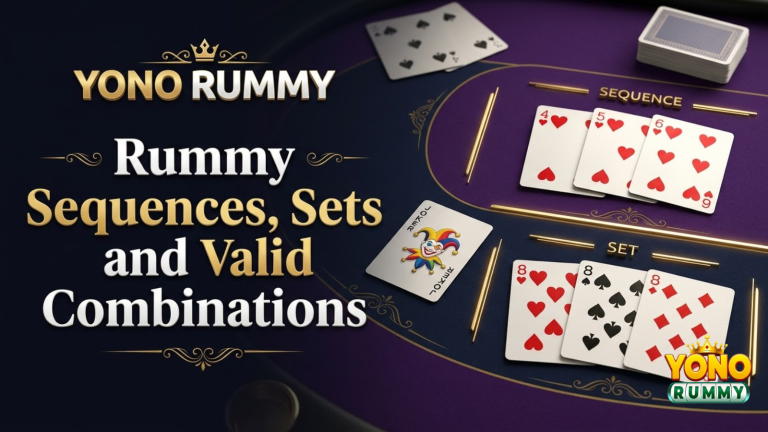
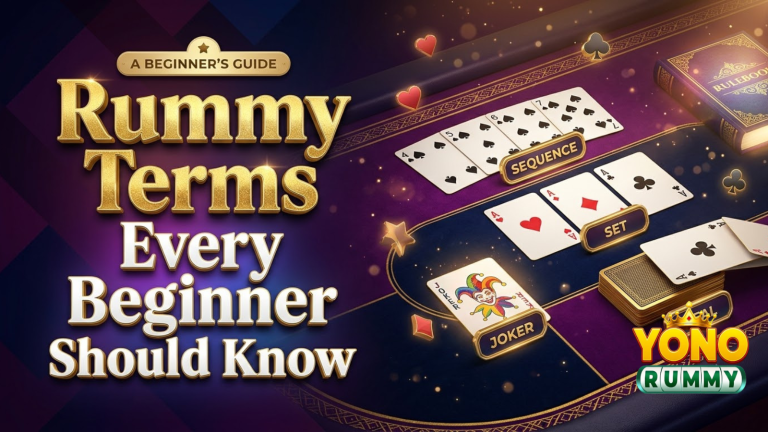
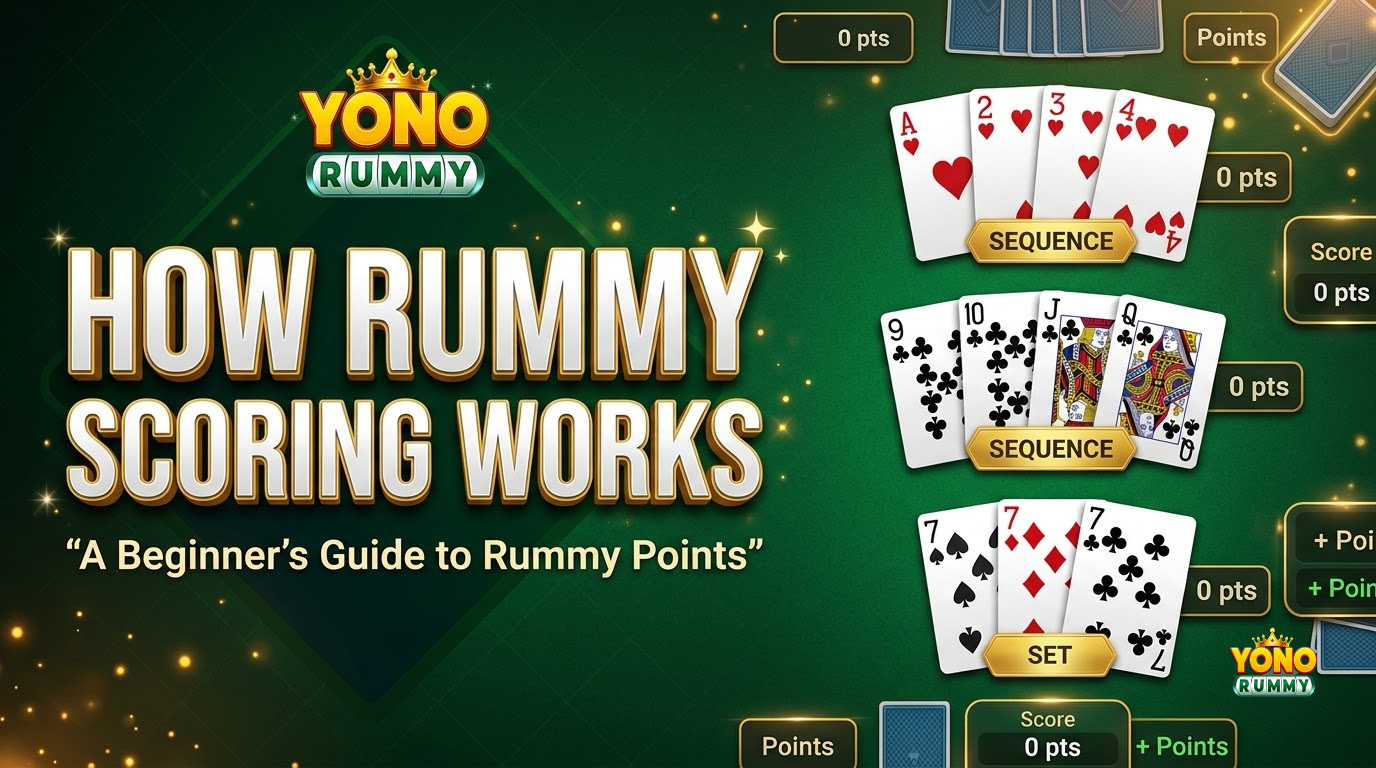
A sequence consists of consecutive cards of the same suit. A set consists of cards of the same rank from different suits.
For example:
- 4♥, 5♥, 6♥ is a valid sequence.
- 7♠, 7♥, 7♦ is a valid set.
A pure sequence does not contain a joker used as a substitute for another card. A sequence that uses a joker as a substitute is commonly called an impure sequence.
These combinations matter because cards placed in valid combinations generally do not contribute to the player’s unmatched-card score.
Yono Rummy Card Points: How Much Is Each Card Worth?
The first step in understanding Yono Rummy scoring is learning the point value of each card.
In standard Indian 13-card rummy, the usual card values are:
| Card | Point Value |
|---|---|
| Ace (A) | 10 points |
| King (K) | 10 points |
| Queen (Q) | 10 points |
| Jack (J) | 10 points |
| 10 | 10 points |
| 9 | 9 points |
| 8 | 8 points |
| 7 | 7 points |
| 6 | 6 points |
| 5 | 5 points |
| 4 | 4 points |
| 3 | 3 points |
| 2 | 2 points |
| Printed Joker | 0 points |
| Wild Joker | 0 points |
The value of a card is used when it remains unmatched at the end of a round.
For example, if a player has an unmatched King, 8 and 5, the total is:
10 + 8 + 5 = 23 points.
The player would generally receive 23 points, subject to the game’s scoring rules and any applicable penalties.
How Are Jokers Counted in Yono Rummy?
Jokers are important because they can help complete combinations.
A printed joker or a designated wild joker can usually substitute for another card in an eligible combination. Jokers generally carry zero points when left unmatched.
However, a joker cannot be used to replace a card in a pure sequence.
For example:
- 5♣, 6♣, 7♣ is a pure sequence.
- 5♣, Joker, 7♣ may be an impure sequence if the joker represents 6♣.
The exact use of jokers depends on the game’s rules.
How to Calculate Rummy Points: A Simple Example
Let’s understand rummy points calculation with an example.
Suppose a player has the following 13 cards:
| Cards | Combination | Points |
|---|---|---|
| 4♥, 5♥, 6♥ | Pure sequence | 0 |
| 7♠, 8♠, 9♠ | Sequence | 0 |
| K♣, K♦, K♥ | Set | 0 |
| 3♦, 8♦, Q♣ | Unmatched cards | 21 |
The unmatched cards are:
- 3♦ = 3 points
- 8♦ = 8 points
- Q♣ = 10 points
The total unmatched-card score is:
3 + 8 + 10 = 21 points.
The player has 21 points from unmatched cards.
If the player makes a valid declaration, the score may be zero for that player. If another player declares first, the unmatched cards may determine the player’s penalty score.
This example shows why forming valid combinations is important in rummy.
How Is the Winner’s Score Calculated?
In a standard points rummy game, a player who makes a valid declaration generally receives zero points for that round.
The other players receive points based on the cards that remain unmatched in their hands.
Consider this example:
| Player | Unmatched Cards | Score |
|---|---|---|
| Player A | Valid declaration | 0 |
| Player B | 3, 5 and K | 18 |
| Player C | 7, 8 and Q | 25 |
| Player D | 2, 4 and J | 16 |
Player A has won the round with a valid declaration.
The remaining players receive points based on their unmatched cards:
- Player B: 3 + 5 + 10 = 18 points.
- Player C: 7 + 8 + 10 = 25 points.
- Player D: 2 + 4 + 10 = 16 points.
The winner’s score is zero, while the other players receive their respective penalty points.
The maximum penalty score is commonly capped at 80 points in standard Indian points rummy. However, the exact cap and penalty rules should be checked for the particular game format.
What Happens If a Player Makes an Invalid Declaration?
An invalid declaration occurs when a player declares a win without meeting the required hand conditions.
For example, a player may have:
- Only one valid sequence.
- No pure sequence.
- An incomplete or invalid set.
- Cards that do not form the required combinations.
In many standard Indian rummy formats, an invalid declaration results in an 80-point penalty.
However, this is a common rule rather than a universal rule. Different platforms and game formats may apply different penalties.
Before playing, check the specific declaration rules and penalty conditions.
How Does Scoring Work in Different Rummy Games?
Rummy scoring can change depending on the format being played. Understanding the difference between Points Rummy, Pool Rummy and Deals Rummy can help beginners avoid confusion.
1. Points Rummy
Points Rummy is a short-format game in which players receive scores based on their unmatched cards.
The winner generally receives zero points, while the other players receive penalty points.
A predefined monetary or game value may be assigned to each point in real-money versions.
For example, if a point is valued at ₹1 and a player receives 25 points, the corresponding point-based amount would be ₹25 before any applicable platform rules or charges.
This is only an illustrative calculation. The point value and settlement rules must be confirmed for the specific game.
2. Pool Rummy
Pool Rummy is played over multiple rounds.
Players accumulate points from their unmatched cards. The objective is generally to remain below a specified points limit, such as 101 or 201.
A player who reaches or exceeds the applicable limit is eliminated.
For example, in a 101 Pool game:
| Round | Player’s Score | Cumulative Points |
|---|---|---|
| Round 1 | 25 | 25 |
| Round 2 | 18 | 43 |
| Round 3 | 30 | 73 |
| Round 4 | 20 | 93 |
The player has accumulated 93 points and remains below the 101-point limit.
If the player receives another 15 points, the cumulative total becomes 108, exceeding the limit.
The exact elimination rules depend on the pool format.
3. Deals Rummy
Deals Rummy is played over a fixed number of deals.
Each player starts with an agreed number of chips or points, depending on the format. Scores are calculated after each deal, and the results are carried forward.
The player with the best overall result at the end of the agreed deals is generally the winner.
The specific scoring and settlement rules depend on the version being played.
Common Mistakes Beginners Make in Rummy Scoring
Understanding the scoring rules is easier when you know which mistakes to avoid.
Counting Cards in Valid Combinations
Players sometimes include cards from completed sequences or sets in their unmatched-card total.
In standard scoring, cards that belong to valid combinations generally do not contribute to the unmatched-card score.
Forgetting the Value of Face Cards
Jacks, Queens, Kings and Aces commonly carry 10 points each.
A player who leaves several face cards unmatched can accumulate a high penalty score.
Confusing Pure and Impure Sequences
A pure sequence does not use a joker as a substitute.
A sequence that uses a joker as a substitute is generally considered impure.
A valid declaration usually requires at least one pure sequence.
Ignoring the Game Format
Points Rummy, Pool Rummy and Deals Rummy use different scoring structures.
A scoring rule that applies to one format may not apply to another.
Always check the rules of the particular game before relying on a scoring example.
Frequently Asked Questions About Yono Rummy Scoring
1. How does Yono Rummy scoring work?
Yono Rummy scoring should be understood through the rules of the specific rummy format being played. In standard 13-card Indian rummy, unmatched cards contribute points, while cards in valid combinations generally do not.
2. How do you calculate rummy points?
Add the point values of the unmatched cards in your hand. Number cards carry their face value, while Aces and face cards commonly carry 10 points each. Jokers generally carry zero points.
3. What is the value of an Ace in rummy?
An Ace commonly carries 10 points in standard Indian 13-card rummy. Its use in sequences depends on the applicable rules.
4. How many points does a joker carry in rummy?
A printed joker or wild joker generally carries zero points when unmatched. It can also help complete eligible sequences or sets.
5. What is the maximum score in rummy?
In many standard Indian points rummy formats, the maximum penalty score is capped at 80 points. Other formats may use different caps or penalty structures.
6. Does the winner get zero points in rummy?
In standard points rummy, a player who makes a valid declaration generally receives zero points for the round. The exact scoring rules depend on the format.
7. What is the difference between Points Rummy and Pool Rummy?
Points Rummy generally calculates scores after each round, while Pool Rummy accumulates points over multiple rounds until players reach the applicable elimination limit.
8. Is rummy scoring the same on every platform?
No. The basic card values are common across many Indian rummy formats, but declaration rules, penalties, point caps and settlement conditions can vary between platforms.
Conclusion
Understanding rummy scoring becomes easier once you know the value of each card and how valid combinations work.
In standard Indian 13-card rummy, the main scoring principle is straightforward: unmatched cards contribute points, while cards arranged into valid sequences and sets generally do not. A valid declaration usually gives the winner zero points, and the remaining players receive scores based on their unmatched cards.
If you are learning Yono Rummy scoring, begin by understanding pure sequences, impure sequences, sets and card values. Then familiarise yourself with the rules of the specific format you are exploring.
Remember that different rummy formats can use different scoring systems. Always review the current game rules before playing, particularly where real-money participation is involved.
Responsible gaming note: Real-money gaming involves financial risk. Do not treat it as a source of reliable income. Only participate if you meet the applicable age and location requirements, and never spend money you cannot afford to lose.